Repositories & Records
The Boyd County Courthouse in Ashland holds deeds,
marriage
records, probate files, and circuit court
orders dating back to the county's early years. Microfilm copies of many volumes are available through
the
Kentucky Department for Libraries and Archives (KDLA).
Additional regional resources for researchers can be
found at the
Kentucky History Center in Frankfort.
Other local resources include the
public libraries.
Notes
Notable Places:
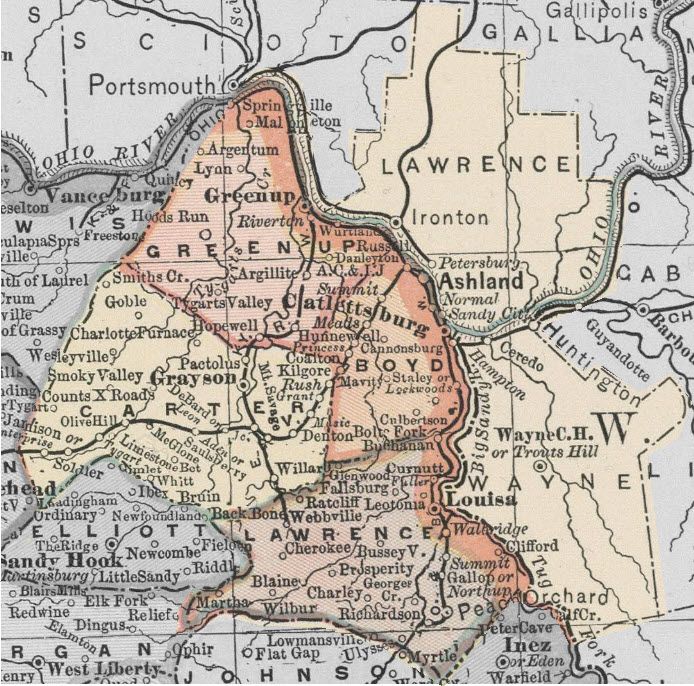
Early and later communities include Catlettsburg (original county seat), Ashland, Cannonsburg,
Princess, Rush, Durbin, Coalton, Meads, England Hill, Summit, Westwood, Ironville, and
Lockwood. Several of these originated as furnace, mining, or railroad villages along
the Ohio River or the old Midland Trail.
Research Notes:
The rapid rise of Ashland’s iron industry (1850s–1890s)
created a large labor population whose movements may appear first in furnace ledgers,
industrial censuses, and city directories. Catlettsburg’s role as a river port means
newspapers, court cases, ferry licenses, and river-trade records often include
travelers or families who lived briefly in the area. Several communities were later
absorbed into Ashland, so locating early streets or neighborhoods may require comparing
historic maps across decades.
Migration Patterns:
Many families moved in and out of Boyd County through the Ohio River corridor, especially
from Lawrence County, OH and Wayne County, WV. Post-Civil War movement of miners,
railroad workers, and furnace hands often creates gaps in county presence; city
directories and employment rosters are key substitutes.
Map is from the 1891 Appleton Map of Kentucky.
Found in the David Rumsey Map Collection.