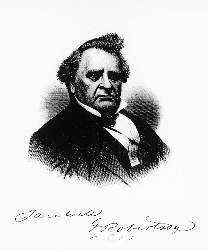
Judge George Robertson
Biographical Summary
- Born near Harrodsburg, Mercer County, Kentucky, 18 Nov 1790
- Attended Transylvania University, Lexington, Kentucky
- Admitted to the bar in 1809; practiced law in Lancaster, Kentucky
- U.S. Representative from Kentucky, 1817–1821
- Chairman, Committee on Private Land Claims (15th Congress)
- Member of the Kentucky House of Representatives, 1822–1827; Speaker for four years
- Secretary of State of Kentucky, 1828
- Associate Justice, Kentucky Court of Appeals, 1829
- Chief Justice, Kentucky Court of Appeals, 1829–1834
- Professor of Law, Transylvania University, 1834–1857
- Member of the Kentucky House of Representatives, 1848, 1851, 1852; Speaker in final two terms
- Justice, Kentucky Court of Appeals (Second District), 1864–1871
- Died in Lexington, Kentucky, 16 May 1874
- Interred at Lexington Cemetery
Letter to George Robertson, 1855
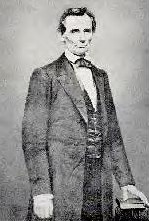
Judge George Robertson was a lawyer, professor of law, and former Congressman from Kentucky. He had previously served as legal counsel for Abraham Lincoln in the matter of his father-in-law’s will. Robertson later provided Lincoln with a volume of his speeches and writings on slavery and other topics, prompting the following letter.
Text from Roy P. Basler (editor), The Collected Works of Abraham Lincoln, vol. II, pp. 317–319.
Springfield, Illinois
15 Aug 1855
Hon. Geo. Robertson
Lexington, Kentucky
My Dear Sir:
The volume you left for me has been received. I am really grateful for the honor of your kind remembrance, as well as for the book. The partial reading I have already given it has afforded me much of both pleasure and instruction.
It was new to me that the exact question which led to the Missouri Compromise had arisen before it arose in regard to Missouri, and that you had taken so prominent a part in it. Your short, but able and patriotic speech upon that occasion has not been improved upon since by those holding the same views; and with all the lights you then had, the views you took appear to me as very reasonable.
You are not a friend of slavery in the abstract. In that speech you spoke of “the peaceful extinction of slavery,” and used other expressions indicating your belief that the institution was, at some time, to have an end.
Since then we have had thirty-six years of experience; and this experience has demonstrated, I think, that there is no peaceful extinction of slavery in prospect for us. The signal failure of Henry Clay and other good and great men in 1849 to effect anything in favor of gradual emancipation in Kentucky extinguishes that hope utterly.
Our political problem now is, “Can we, as a nation, continue together permanently—forever—half slave and half free?” The problem is too mighty for me. May God, in His mercy, superintend the solution.
Your much obliged friend and humble servant,
Abraham Lincoln