
Dr. David Bell Houses
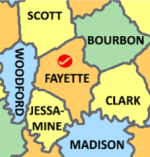
Spring Street - Lexington, Fayette
County, Kentucky
Built 1814
Source: Old Houses of Lexington, C. Frank Dunn, typescript, n.d., copy located in the Kentucky Room, Lexington (Kentucky) Public Library.
One of the show places a century and a quarter ago, when it had columns facing High St., and there was no "Spring Street" (opened in 1814) to mar its lawn, this house has enjoyed a long career of distinguished occupants and entertainments. Its leaded windows on one side and panels on the other bespeak its past glory.
The first to occupy it probably was James Haggin, who built it in 1814. He later built "Castle Haggin" on North Broadway (now Hamilton College) and removed there. On October 6, 1816, James Haggin and his wife, Hetty (Esther) sold the High St. house to John Lowman "subject to a lease made by said Haggin to a certain John Price now in possession, and a contract with a certain Duval, with liberty however to said Lowman to receive the rent reserved on the lease to the said Duval coming on the first day of January next."
Lowman moved in at the expiration of the lease - he got a second deed June 10, 1817, for the house "now occupied by said Lowman." (1818 Dir. "John Lowman, Rope-maker, High St.")
He gave a mortgage temporarily to Major Wm. W.S. Dallam January 6, 1821, on the house "wherein he at present resides, deeded from Jas. Haggin," the mortgage to cover the hire of a "negro man named Henry," from John M. Coleman."
Lowman died in 1827 and willed all his estate to "my children Eliza Lowman and Thomas Lowman and my grandchild Thomas Hickey and my sister-in-law Kitty Lewis." He said it was his desire that Kitty Lewis should have charge and care of the children and grandchild and occupy the "house where I reside."
The Farmers Bank brought suit against the estate and the house was sold at auction in 1834. Mayor Charlton Hunt came to the rescue however; bid in the property, and conveyed it to Kitty Lewis for less than he paid for it.
Rev. Edward McMahon bought it June 17, 1838 and conveyed it next day to Prof. Jas. Logue ("teacher" - 1838 Dir.) who lived across the street.
Judge George Robertson in July, 1858, purchased the place from Jas. Logue* and an adjoining 40 feet on Spring St. He presented them to his daughter, Charlotte, wife of Dr. David Bell (1859-60 Dir.: "David Bell, regular physician, h. w.s. Spring St. b High & Maxwell.") In 1869 Mrs. Bell bought of Dr. Jas. S. Lane the next 40 feet on Spring St., which reached on the back "a part of Mrs. Bell's dwelling house." The latter 40 feet was the site of Dr. Lunsford P. Yandell's residence in the 1830's - a "white frame house" built by Samuel Maxwell in 1819 and which Dr. Yandel purchased of Parmelia Stout in 1835."
Dr. Bell on May 12, 1857, traded "a negro boy named Calvin, valued at $600" to Thos. H. Waters for the latter's "quarry lot", located between Merino Street and the Southern Railroad and South of M.C. Johnson's property. the deed stated that "said lot is known as the quarry lot, containing the old Patterson Cave."
John Robert Shaw, the famous well-digger, had been operating this old quarry more than a half-century before this.
In February, 1799, Shaw advertised "excellent lime at his lime house about half a mile from Lexington, at Col. Patterson's quarry, at 10d half-penny per bushel, giving ten bushels for every hundred sold; he will have two or three thousand bushels ready by the last of April - He also - will carry on the well digging business as usual, his prices are 2s and 6d per foot, through earth, if a cavity, or as far as a cavity extends into rock, 9s per foot, 15s per foot for the first three feet after, and 18s per foot as far as the well is continued, 2s per foot for walling, boarding, laborers, powder, smith's work, &c. found by the owner of the well. J.R. SHAW, Patterson's Quarry, near Lexington."
Dr. David Bell, son of David and Nancy Holmes Bell, was born July 9, 1810, on a 500 acre farm near Lexington, which his father had bought in 1806 upon coming here from Staunton, Va. He was graduated from Transylvania University in 1832. He married Charlotte Corday Robertson, daughter of Chief Justice George W. Robertson, June 5, 1834, and was one of the leading physicians and surgeons in this city until his death at an advanced age.
*Prof. James Logue raised the finances and re-opened the Lexington Library in May, 1846, establishing it in the old Transylvania Medical Hall at Market and Church Sts., where it suffered from a disastrous fire about 10 years later. The library after a long career had closed in 1841, "due to deaths of subscribers, etc." Prof. Logue was librarian for more than 25 years. He had conducted a private school many years before acting as librarian.
Transcribed by pb October 2002
316 South Broadway,
Lexington, Fayette County, Kentucky
Built 1845
Source: Old Houses of Lexington, C. Frank Dunn, typescript, n.d., copy located in the Kentucky Room, Lexington (Kentucky) Public Library.
Be prepared for a "load" of history in connection with this location. The story of this south-west corner of Broadway and High St., necessary to introduce the "Polly Adams House," goes back more than 160 years to Lexington's "fort on the hill."
The siege of Bryan Station in August, 1782, quickly followed by the ill-fated Battle of Blue Licks, where "the flower of the manhood of the West" fell and "many widows were made in Lexington," to use Daniel Boone's words, greatly alarmed the inhabitants of Lexington.
"They set to and built a large fort, very strong and surrounded with a ditch on the outside, up where Keiser's lot (afterwards) was, right opposite to Caldwell's on the hill. ... This fort was intended to be cannon-proof." (Wymore in Draper MSS - Staples History).
Wymore's statement that the fort was opposite Caldwell's and "where Keiser's lot afterwards was" is fully borne out by the deeds to this corner.
After danger of an organized Indian attack upon Lexington ceased, Moses Patterson purchased the lot (Outlot "R"), which extended south to Maxwell St. and west on High St. half-way to Spring St.
Patterson sold the lot to Christopher Keiser, who operated one of Lexington's earliest taverns, "The Indian Queen," on this corner. George Adams, wealthy Lexington merchant, bought the outlot from Christopher Keiser - and that's where the story of this house, today considerably back on Broadway from the corner, begins.
A deed to Polly Adams September 30, 1833, by Sheriff, for the High Street (Broadway to Spring) half of Outlot "R" stated that a Fayette Circuit Court writ for some $2,500 had been levied on "a lot of ground situated at the corner of Hill and Main Cross Sts., containing four acres (suit in favor of George Adams vs. John Keiser, Elizabeth Keiser, Adam Keiser and Mary Irwin, heirs of Christopher Keiser, dec'd., William Macbean, Joseph Claar, and Benjamin Keiser). The lot was sold by the Sheriff September 4, 1822, and George Adams purchased it for $2,667.17.
"By Adams' order one-half of said lot was conveyed to Robert Wickliffe, and said Adams having departed this life without a deed being made to him for the other half," a suit was instituted by Polly Adams and John Adams against George Adams' heirs for the other half. By court decree June, 1830, the Sheriff was directed to convey to Polly Adams "the part of said lot not conveyed to Robert Wickliffe." As Robert Wickliffe sold his half to John McMurtry, which makes the starting point for some other houses here on Broadway, the above data is cited in detail.
Polly Adams sold the lot March 24, 1841, to Hugh Loney. It extended 205 feet south on Broadway from the corner "to Robert Wickliffe's lot" and west to the line of William Bell ("Wm. Bell House").
Dr. David Bell purchased it from Loney and built and occupied the house here. Adjoining deeds mentioned his living here and a deed of Dr. S.M. Letcher to Dr. Bell for the north-west corner of Broadway and High in 1847 said the latter was "opposite the residence of said Bell." The houses from here to High Street have been built more recently.
Dr. Bell and wife, Charlotte (daughter of Chief Justice George Robertson), sold "that house and lot on the corner of Broadway and Hill St. on which the said Bell and wife now reside" June 9, 1858, to J.R. Dunlap for $11,500.
John T. Miller purchased the residence in 1863, and James M. Graves bought it in 1887. The latter's daughter, Mrs. George C. Webb, resides here today.
When Dr. Bell bought the lot from Hugh Loney April 11, 1845, Keiser's old tavern must have been here still. The deed called for "the buildings, improvements, premises and appurtenances." The conveyance further stated: "It is understood that said Hugh Loney has leased to Shryock and Walker part of the land by written lease dated Sept. 10, 1842, which lease is also assigned to said Bell." The deed was "not to affect the lease" other than to assign it to Dr. Bell.
The next month (May, 1845 Dr. Bell sold John McMurtry 13 feet between his and Wm. Bell's lot on High Street, "to be kept open always as a street." McMurtry then opened "Brown Street," as it is known today, from High to Maxwell Streets.
Transcribed by pb October 2002
Updated December 13, 2025.