
Ayres Tavern - Sign of the Cross Keys
S.W. Cor. Main & Spring Streets, built 1795
One of the most famous taverns of early 1800s, occupied the long house here, which is a typical example of the finest store and residential buildings of a century and a quarter ago in the frontier of Lexington.
It was built in 1795 by William West.
Capt. William West in 1795 had bought Inlot No. 34, fronting 66 feet on Main and Water Streets and extending back along Spring Street, for £150 from William Morris Protheroe “of the Town of Cincinnati in the Territory North West of the Ohio River.” Protheroe had gotten it from Robert Parker, to whom it had been granted by the Town Trustees “;for his actual residence in the said Town.”
On October 8, 1796, William West advertised in the Kentucky Gazette, “For Sale—The BRICK BUILDING on the lower end of Main Street in which he at present resides. It is in good repair and very convenient for a family.”
The house was not sold then, however, and Captain West, who had operated large stores in various locations in the town since the early 1790s, announced December 8, 1800, that he had “removed his merchandise from this town” and intended going to Philadelphia and Baltimore. “Any person having business to transact with him will be pleased to call at his house near the lower end of Main Street.”
He evidently returned to Lexington shortly and remained here until his death Sept. 21, 1831—“Capt. Wm. West, of Lexington, at an advanced ago.” (Reporter)
Thomas Hart, Jr., purchased the lot from William West and wife, Lucy, in April, 1805, for £900. Less than a year later Hart and wife, Eleanor, sold it to Eglehard Yeiser for $3,000, after which for the first time its occupants were recorded.
Yeiser leased the property to the famous Lewis Sanders in May, 1810—“all that Messuage, Tenement and lot situated in the West corner of Main and Spring Streets known by its No. 34, together with all its appurtenances and outhouses now in the possession and occupation of said Lewis Sanders.” The lease was for seven years, beginning September 1, 1809, at a yearly rental of $400 “gold or silver of the United States of America,” with the privilege of purchase at the price of $5,000 “by such conveyance as counsel learned in the law may devise.” Pesumably Sanders already had been occupying the building, as the 1808 Directory lists “Lewis Sanders, Merchant, Main Street.”
It was just at the expiration of Sanders' lease that he opened his large cotton manufactory on Town Branch about a mile west of the town. He employed 150 operatives, making cotton yarns, sheeting, shirting, bedticking, counterpanes, table cloths, chambrays, cassinets, sattinets, cords, etc.
Yeiser issued a mortgage on the property in July, 1821, to Chas. Humphreys, and described it as bounded “by Spring, Main and Water Streets and the lot on which the Brewery stands, being the lot on which Ayres keeps tavern and known as Inlot No. 34.” The 1818 Directory lists “Benjamin Ayres, Innkeeper, Main St.,” so the noted Ayres must have leased the commodious building after Sanders' lease expired.
The Kentucky Gazette in [April], 1820, was carrying the following ad, headed by two crossed keys:
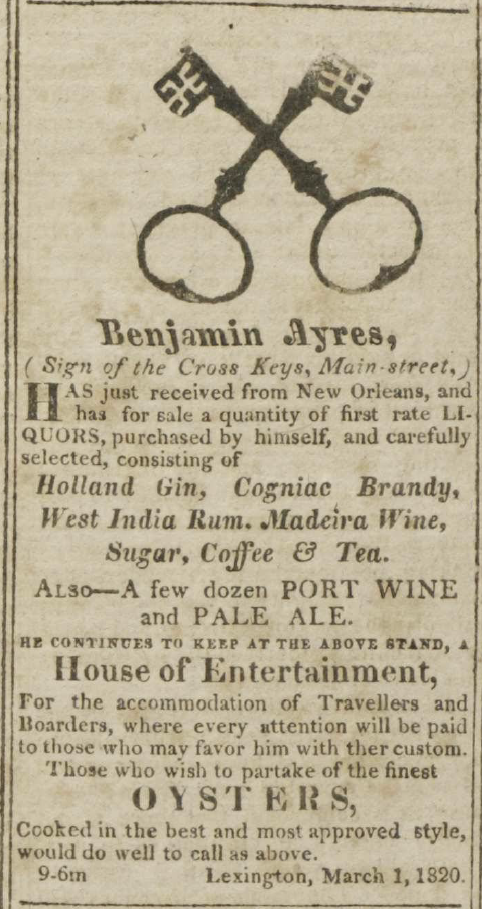
Kentucky Gazette, 21 Apr 1820. Courtesy of the Lexington Public Library.
In 1824 and 1825 Benjamin Ayres was operating the Washington Hotel (“At the Sign of George Washington”), north-west corner of Broadway and Short, where he was succeeded in 1826 by the famous tavern-keeper Charles Wickliffe.
The next owner of “Lot No. 34” was Joseph Bruen, who manufactured a steam engine that ran over the “first railroad in the West.” Bruen, in a mortgage to the Bank of the United States, March 22, 1827, stated in the conveyance that he had purchased the property three days before from Englehard Yeiser.
History says Thomas Barlow, the inventor, produced the model of the first steam engine “on Spring St. between Main and Water Sts.” and the above mentioned ownership of “Lot No. 34” by Bruen accounts for both the historical site and the connection between Barlow and Bruen.
(Before Barlow occupied the building above mentioned, and two years before Bruen bought the property, the first meetings to organize the “Disciples' Church” were held here, in 1825. They held to the tenets expressed by Alexander Campbell, and were addressed by Elder Jos. “Raccoon” Smith. Elders Wm. Poindexter and Thomas Smith, also, were members of these organizational meetings. This was before the“Christian” and “Disciples” united or undertook to build a church.)
Thomas Barlow on August 8, 1834, conveyed to Joseph Bruen to secure a $345 debt all of his household furniture, “an instrument for punching boiler iron, shears for cutting iron, three smith's vices,” etc. Barlow was to retain the personalty “during the will and pleasure of Bruen” and to pay $5.00 per month for its use meantime.
Like all inventors of early days, he was more concerned about time to develop his genius, than time to accumulate wealth. His inventive career was long and notable. He came to Lexington in 1825 (born in Nicholas County in 1789). In 1827 he produced a locomotive with two cars, which he exhibited publicly on a circular track, charging 50 cents a ride—it was the sensation of the town. He produced the locomotive in 1835 for the Lexington and Ohio Railroad. He invented a self-feeding nail and tack machine.
In 1845, in the silversmith shop of his son, Milton Barlow, he began the Barlow Planetarium. The latter took three years to perfect, when it was exhibited in a building at the corner of Main and Upper Streets. The first one made was purchased for Transylvania University—one may be seen in Sayre College here. The United States Government bought them for use at Washington, West Point and Annapolis, and it was exhibited at the World'sFair in New York in 1851.
In 1855, Barlow perfected a rifled percussion cannon which he had invented in 1840. Congress appropriated $3,000 for its testing and experimental manufacture (cast in Pittsburgh) and it is believed to have been the pattern used by later inventors of rifle-bore guns.
Barlow died in 1865, but his son, Milton, returning from the Confederate Army, gathered together the fragments of nine thousand dollars' worth of planetariums that troops had demolished while occupying Lexington, and made two. He was enabled by the Kentucky Legislature to exhibit one of them at the World's Exposition in Paris, France, in 1867, which received the highest award.
Before leaving, attention is called to the sites of the tan yards along here. Englehard Yeiser had one at the north-east corner of Spring and Water, Archibald Logan at the Broadway end of the block and Wm. Morton at the next corner (Main and Patterson Streets).
Source: Dunn, C. Frank. Old Houses of Lexington. Lexington Public Library, 1976.
Transcribed by P. Brinegar, January 2001.
Updated January 7, 2026.