
Revolutionary War
There were only a handful of small settlements in the remote and unorganized area known as "Kentucke" country when the American War for Independence began in 1775. Colonial government (and its records) only existed east of the Appalachian mountains. So it is often assumed Kentucky had no role in the Revolutionary War when in fact, it was a violent "Western Front" where settlers fought British-backed Native American tribes to secure the region for the colonists. ~Pat Asher
Background
Britain, France and Spain had fought each other for control of the North American continent almost since its discovery by European explorers. By the 1750's, Britain had colonies on the eastern seaboard from Maine to Georgia, as well as Nova Scotia in Canada. The holdings of New France stretched from the Gulf of the St. Lawrence River through the Great Lakes, and down the Mississippi River to the Gulf of Mexico. With the Atlantic Ocean on the East, the French to the West, and the Spanish in Florida, the British Colonists were boxed in. Caught in the middle of the various European claims were the indigenous Native Americans, who had occupied the land for generations. (See Map)
The last major war preceding the revolution was the French and Indian War (1754-1763). While a British victory, the immense cost of the war led to increased taxation of the American colonies, fueling the unrest that would spark the American Revolution. The area of contention that was the spark for this war was the 200,000 square mile region known as the Ohio River Valley, which included the Old Northwest Territory north of the river, and Kentucky, Tennessee, and West Virginia on the south. The Ohio River was crucial for the French to maintain communication with its military outposts and settlements to the south. The 1763 Treaty of Paris ended the war with France ceding its holdings between the Mississippi River and the Appalachian mountains to Britain. But to prevent conflict between Native Americans and white settlers in the newly acquired territory, King George III issued the Royal Proclamation of 1763 which forbade white colonists from settling west of the Appalachian Mountains and ordered existing settlers to remove themselves. Settlers and land speculators in Britain and America objected to these restrictions since they had furnished supplies or fought against the French and their indigenous allies to gain access to that land; and many had been given land grants for their service.
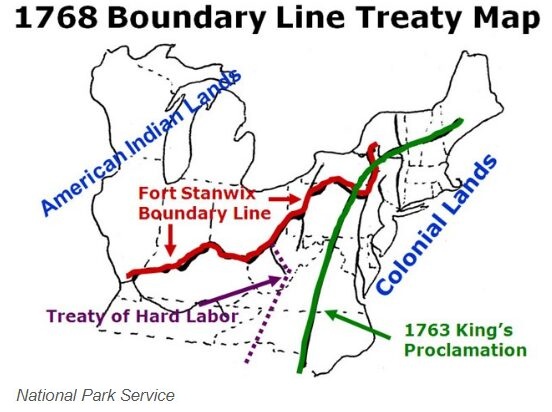 British officials negotiated two treaties with Native Americans in 1768. In October, the Treaty of Hard Labor between the British and the Cherokee Nation ceded Cherokee land claims in present day West Virginia and Kentucky to Britain. In November, the Iroquois Confederancy agreed to relinquish their claims south of the Ohio River in the Treaty of Fort Stanwix.
Even before the treaties, Long Hunters (frontiersmen who traveled to hunt and trap for months or even years at a time) had made forays into Kentucke country. Frontiersman and hunter Daniel Boone made his first successful trip to Kentucke country in 1769. But most of the Native Americans who lived and hunted in the Ohio Valley, Shawnees, Mingos, Lenape, and Wyandots, had not been consulted in the treaties. Angry with the Iroquois for selling their lands to the British, Shawnees began to organize a confederacy of western tribes with the intention of preventing the loss of their lands. They considered the hunters to be poachers and they continued to harass and attack any who attempted to hunt or settle the territory.
Early Settlements
In September 1773, Daniel Boone gathered his family and about 50 others and led them up the Powell River valley in Tennessee in the first attempt by white colonists to establish a permanent settlement in Kentucke country. On October 9, just south of the Cumberland Gap, Boone's oldest son James, age 16, and a small group of men and boys who were retrieving supplies were attacked by a band of Delawares, Shawnees, and Cherokees. James Boone and Henry Russell, a teenage son of future Revolutionary War officer William Russell, were captured and tortured to death. The brutality of the killings shocked the settlers along the frontier, and Boone's party abandoned their expedition.
The following April, an expedition led by George Rogers Clark started down the Ohio River on their journey to Kentucke country. They reached the mouth of the Little Kanawha River (Parkersburg, West Virginia) where they were to wait for another group of settlers led by Michael Cresap. While waiting, they heard tales of natives ambushing and killing the Europeans floating down the river and it was decided to retreat to Zanesburg (Wheeling, West Virginia) and wait for calm. But when they arrived at Zanesburg they found it was also under attack by some of the natives there. The Mingo indians, however, who lived across the Ohio River from Zanesburg were friendly to the colonists. Chief Logan's daughter, Koonay, had even married a local trader by the name of John Gibson and was carrying his child. But the settlers were enraged at all natives, friendly or not. They invited the Mingo to visit, then ambushed and killed them, including Logan's daughter and her unborn child in the Yellow Creek Massacre (Apr 30, 1774). These were among the events that culminated in Lord Dunmore's War (May-October 1774) against the Shawnee and Mingo.
Beginning in the spring of 1774 at Fort Redstone in Pennsylvania, James Harrod led a company of adventurers totaling 31 men, down the Monongahela and Ohio Rivers in canoes. Harrod's Town was laid out and founded on June 16, 1774. Later that same year, amid Dunmore's War, Lord Dunmore sent warning of imminent Shawnee attacks to the settlers. The pioneers remained for a few weeks until a man was killed by the natives, when the settlement was abandoned and not resettled until the following year in March.
Following Dunmore's War, Richard Henderson, a prominent North Carolina judge and land speculator, hired Daniel Boone to help establish a colony to be called Transylvania in the Ohio Valley. In March 1775, Henderson negotiated the Treaty of Sycamore Shoals, a private treaty with the Shawnee and the Cherokee whereby he purchased a large swath of land between the Cumberland River and the Ohio. It included what is now the central and western parts of Kentucky, and a chunk of north central Tennessee. Henderson's treaty and land purchase, however, was illegal. Colonists were not allowed to buy the land at all according to British law. To further complicate matters, the land was claimed by both the Virginia Colony and a southern portion by the Province of North Carolina.
Nevertheless, commissioned by the Transylvania Company and starting on March 10, 1775, Daniel Boone, along with 35 axmen, cut and marked a 200 mile long trail from Long Island in Kingsport, Tennessee, through the Cumberland Gap to the Kentucky River in southeastern Kentucky. This crucial pioneer route (the Wilderness Road) spurred westward expansion, with over 200,000 settlers using it by 1792 when Kentucky became a State. On April 6, 1775, Boone constucted a fort, Boone's Station, along the Kentucky River. Harrodsburg was re-occupied, and Logan's Fort and Lexington were established around the same time. Thirteen days later on April 19th in Massachusetts, local militia clashed with Crown forces at Lexington and Concord, igniting the American Revolution.
The War in Kentucky
American Indians who were unhappy about the loss of Kentucky by treaties saw the American Revolutionary War (1775–1783) as a chance to drive out the colonists. Isolated settlers and hunters became the frequent target of attacks. The British, who also opposed the movement of settlers into Kentucky, gave the Indians weapons and other supplies and leadership. Sometimes their soldiers joined the Indians on raids into Kentucky. Kentuckians responded by fortifying their settlements and by organizing local militia companies that could be called into action quickly. They often conducted their own raids against the Indians.
British prosecution of the war in the western theater fell on the shoulders of Lt. Col. Henry Hamilton, the lieutenant governor at Detroit. Hamilton's main responsibility involved maintaining control of the Ohio River Valley and Canada. With few troops at his disposal, Hamilton depended heavily on alliances with the tribes that inhabited the area around the Great Lakes. By putting pressure on the Americans in Kentucky, Hamilton hoped to divert troops from the colonies and thus weaken the Continental Army. Kentuckians called him the "hair-buyer General" because they believed he encouraged the Indians not only to kill the settlers, but paid the Indians for American scalps.
When the revolution began, Kentucke country was still part of the far Western Territory of Fincastle County, Virginia. In June of 1776, George Rogers Clark (older brother of William Clark of Lewis & Clark Expedition fame) and the young lawyer John Gabriel Jones, were electd by the area's settlers to go to Williamsburg to petition the Virginia General Assembly to formally extend its boundaries to include Kentucky. In December, the Assembly abolished Fincastle and organized three new counties from it, one of which was Kentucky County. Harrod's Town was named the county seat. As a result, instead of a loosely organized home guard, Kentucky County was accorded its own separate and distinct Militia, which was sorely needed to repel the numerous Indian raids on the settlers. Clark was given 500 pounds of gunpowder to help defend the settlements and was appointed a major in the Kentucky County militia. Daniel Boone was commissioned by the Assembly to command Boonesboro.
Major Engagements
 "Defending Fort Logan, 1777"
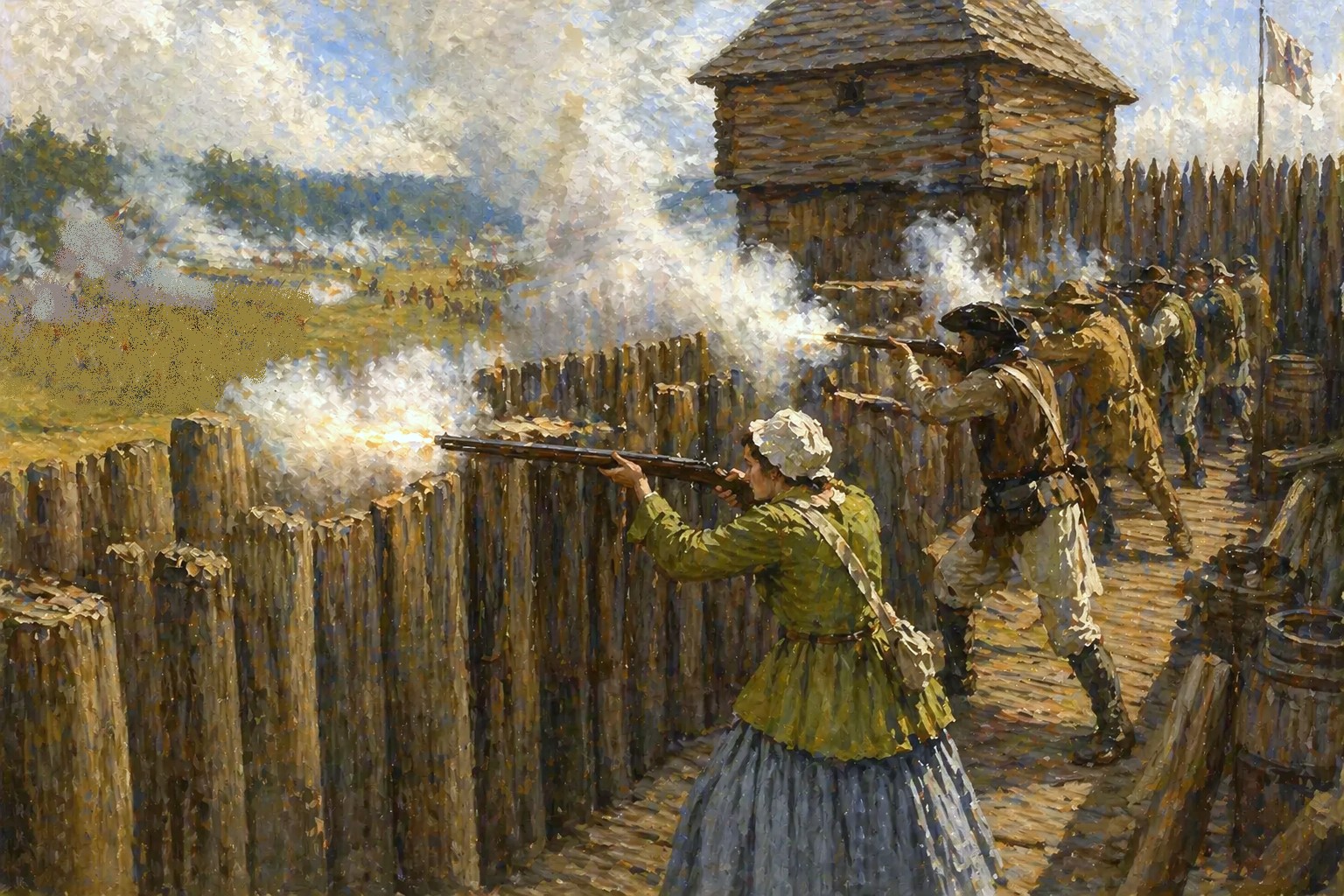
In 1777, the War intensified in Kentucky. In March, the Shawnee war chief Blackfish led a force of 200 warriors into Kentucky. Beginning in April, Blackfish struck at Harrodsburg and Logan's Fort, a key station on the Wilderness Road. Much of their effort centered on Boonesboro. Harassing the fort did not involve the risks of operating against settlements located in the interior as war parties could quickly withdraw to safety north of the Ohio River. Multiple engagements occurred there from April to July. The period ultimately became known as “the year of the bloody sevens”. Rather than launch full scale assaults, the warriors focused their attention on the destruction of crops, animals, and foodstuffs to compel the Americans to abandon Kentucky. The Continental Army could spare no men for an invasion in the northwest or for the defense of Kentucky, which was left entirely to the local population. George Rogers Clark spent several months defending settlements against the Indian raiders as a leader in the Kentucky County militia, while developing his plan for a long-distance strike against the British. His patrols along the Ohio River, with men on horseback and in boats, helped protect Kentucky settlements from British and Indian attacks.
Clark's plan involved seizing British outposts north of the Ohio River to destroy British influence among their Indian allies and relieve the pressure on the Kentucky settlements. In December 1777, Clark presented his plan to Virginia Governor Patrick Henry, and asked for permission to lead a secret expedition to capture the British-held villages at Kaskaskia, Cahokia, and Vincennes in the Illinois country. Governor Henry commissioned him as a lieutenant colonel in the Illinois Regiment of the Virginia State Forces and authorized him to raise troops for the expedition. Originally raised as a special Virginia militia regiment for defense of the Western Department, Clark and his officers recruited volunteers from Virginia, Pennsylvania, and North Carolina.
In July 1778, Clark led about 175 men of the Illinois Regiment and crossed the Ohio River at Fort Massac and marched to Kaskaskia, capturing it on the night of July 4 without firing their weapons. The next day, Captain Joseph Bowman and his company captured Cahokia in a similar fashion without firing a shot. The garrison at Vincennes along the Wabash River surrendered to Clark in August. Several other villages and British forts were subsequently captured after British hopes of local support failed to materialize. To counter Clark's advance, British Col. Hamilton recaptured the garrison at Vincennes, which the British called Fort Sackville, with a small force in December 1778. Clark and his men returned and surrounded Col. Hamilton at Vincennes on February 23, 1779. Unable to endure a siege, Hamilton surrendered three days later.
In February, 1778, Blackfish had captured Boone and a party from Boonesboro while they were boiling salt at the Blue Licks. Boone managed to escape the Shawnee in June and return to Boonesboro. Blackfish and a small army appeared outside the fort in the second week of September. When truce talks broke down, the Shawnees initiated a siege. After twelve days of fighting and unable to capture Boonesboro, Blackfish abandoned the effort. The episode became the longest sustained fight of the war in Kentucky.
Despite Clark’s victories in Illinois, raids continued throughout the summer of 1780. In May, a mixed British-Indian force, led by Captain Henry Bird, and including Shawnee, Lenape and Wyandot warriors, set out from Fort Detroit and invaded Kentucky. Using artillery, they quickly captured both Ruddle's and Martin's Stations along the Licking River north of Boonesboro, and seized hundreds of prisoners. The warriors wanted to continue by attacking Bryan's Station and Lexington. Bird refused, however, citing the lack of provisions and the need to escort the large number of prisoners to Detroit. A war party of 60 warriors headed to Grant's Station without British support. They discovered that the inhabitants had fled but tracked down and killed three stragglers after burning the fort. They returned to the Ohio River and the British and their indigenous allies took separate routes to bring their prisoners to Detroit. Bird's regulars and militia escorted about 150 men, women and children, and suffered greatly from the lack of food caused by the indiscriminate killing of livestock at Ruddle's and Martin's stations. Of the 200–250 prisoners taken by the warriors, most were brought to Detroit and ransomed, but some decided to remain permanently in Canada. In August 1780, Clark led a retaliatory force that defeated the Shawnee at the village of Peckuwe (Piqua, Ohio).
The Battle of Blue Licks would go down in history as the last battle of the American Revolution. In August of 1782, British Capt. William Caldwell led a party of approximately 500 Hurons, Shawnee, Wyandot and Mingo warriors, accompanied by elements from Butler’s Rangers, into Kentucky and laid seige to Bryan's Station. The garrison's sharp-shooters and the militiamen were able to wound or kill any Indian that showed himself and fearing the arrival of reinforcements during a prolonged seige, the Indians withdrew. Militias from around the area converged on Bryan's Station and finding the attackers had withdrawn, the officers held a council. It was decided to give chase to the Indians. Early on the morning of August 19, 1782, the Militia arrived at the south bank of the Licking River near the Blue Licks salt springs. The Indian army lay hidden in a series of wooded ravines at the crest of a hill. As the Militia assembled on the south bank of the river, a group of warriors serving as decoys appeared in plain view on the hilltop. Another officer's council was called. Daniel Boone urged caution; he pointed out things he had noticed on the march and suggested the possibility of an ambush by the Indians. An officer named McCary rejected Boone's advice and calling for the others to follow him, led a charge across the river directly into the ambush and hand-to-hand fighting that followed. The result was disaster for the Kentucky Militia and a resounding victory for the Indian/British force. Seventy-two Kentuckians were killed in the fight; more than a third of their force. The Indian and British lost only three men and four more slightly wounded.
The Battle of Blue Licks occurred ten months after General Cornwallis had surrendered at Yorktown. By this time, about seven percent of Kentucky settlers had been killed in battles against Native Americans, contrasted with one percent of the population killed in the Thirteen Colonies. Lingering resentments led to continued fighting in the west after this war ended. The 1783 Treaty of Paris which officially ended the American Revolution was signed the following September, and recognized the Thirteen Colonies that had been part of colonial British America to be free, sovereign and independent united states.