
Northwest Indian War
and the "Legion of the United States"
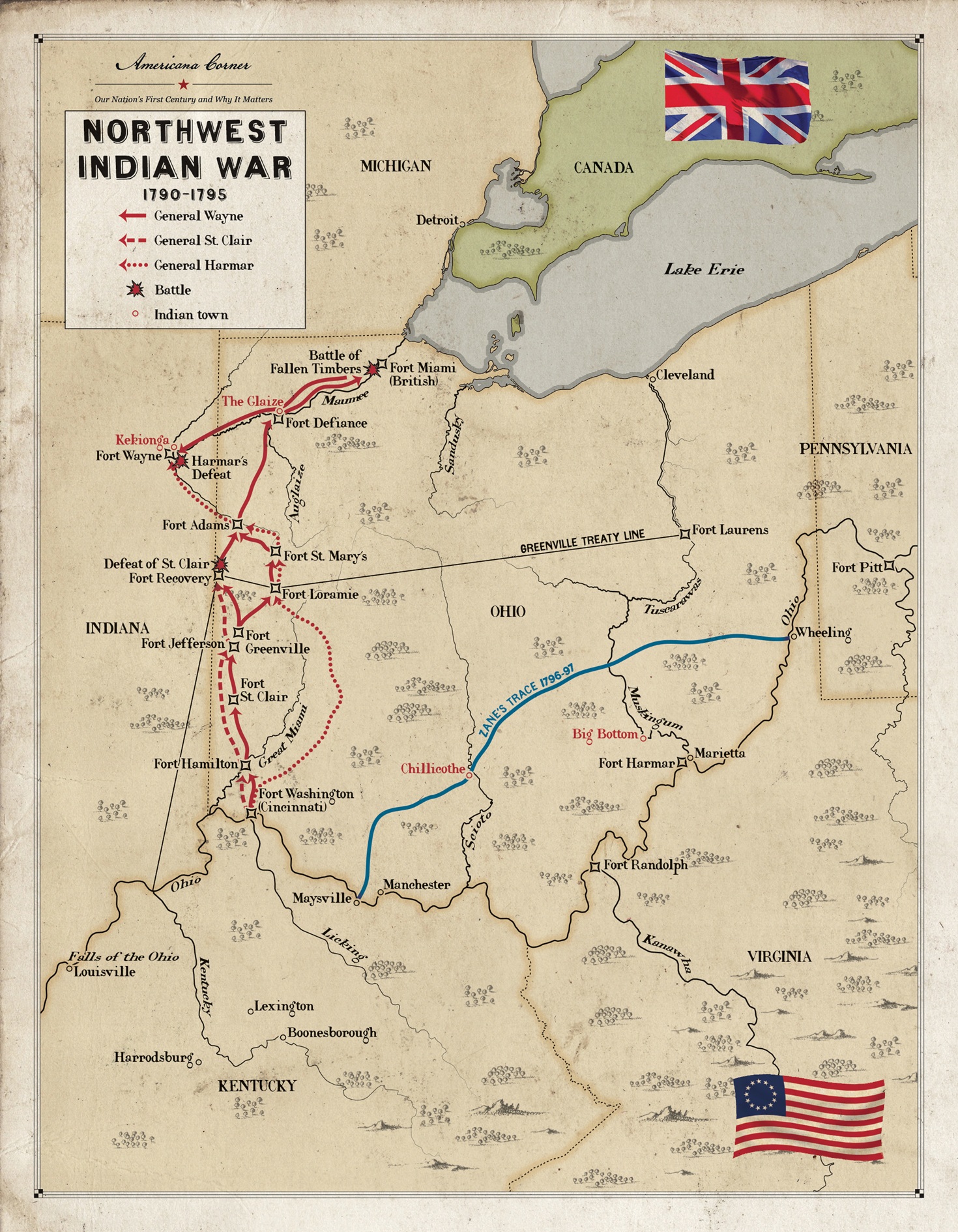 "Northwest Indian War," courtesy Americana Corner
The 1783 Treaty of Paris that granted independence to the former British colonies also ceded the lands between the Appalachian Mountains and the Mississippi River to the new Confederation of the United States of America. But the many Native American Tribes who had not agreed to this or previous treaties formed their own confederacies to continue to resist American expansion onto their lands south of the Ohio River and in the Northwest Territory. And despite signing the treaty, the British remained in place near the Canadian border, maintained their forts there, and continued to furnish arms and supplies that supported the Indians in their opposition to American expansion.
Following the signing of the 1783 treaty, the Congress of the Confederation voted to disband the Continental Army. Many in the United States still feared a standing army and Congress decided to rely instead on volunteer state militias. By 1784, all Continental Army regiments had been disbanded, and the entire United States Army consisted of just 55 artillerymen at West Point and 25 regulars at Fort Pitt (modern Pittsburgh) to guard military supplies. The central government was thus dependent on the state militias, which were notoriously undertrained, ill-disciplined, badly funded, and often refused to fight outside their home states.
But with a large frontier to defend, Congress soon realized a need for a larger force. Thus, it created the First American Regiment to serve in the Western territories. The regiment was organized on 3 June 1784, and was to consist of 700 men from Pennsylvania, New Jersey, New York and Connecticut. Despite his limited command experience and unfamiliarity with Indian diplomacy, Lieutenant Colonel Josiah Harmar (who had served in the Revolution) was named commandant. The Regiment was posted to the old Northwest Territory (now Ohio, Indiana, Illinois, Michigan, and parts of Minnesota) and was charged with carrying out four main missions: controlling immigration to the new lands, building forts, negotiating treaties with the Indians, and protecting surveyors and settlers in the area.
Illegal settlement of the territory had begun prior to the Revolutionary War, but increased dramatically after. The leaders of the fledgling United States wanted to exercise the country's sovereignty over the region, and since the cash-strapped Confederation Congress lacked the authority to levy taxes, they saw the territory as an economic opportunity. Claiming ownership of the land, they could sell it for profit. Congress formally organized the region in the Land Ordinance of 1785 and negotiated treaties allowing settlement, but the Western Confederacy of Native American nations (Miami, Potawatomi, Shawnee, Delaware and others) were not party to these treaties and refused to acknowledge them.
Then on July 13, 1787, Congress passed the Northwest Ordinance, creating a government for the Northwest Territory. The legislation outlined the process for creating new states, making white settlement inevitable and increased the already existing tensions and violence between Native Americans and settlers in the region and in Kentucky.
The Harmar Campaign
The Constitution of the United States went into effect on March 4, 1789. George Washington was sworn in as president, which made him the commander-in-chief of all U.S. military forces. He quickly directed Henry Knox, his Secretary of the Department of War, to enforce American sovereignty over the Northwest Territory. Knox ordered the First American Regiment commander (now brigadier general) Harmar, to lead an offensive against "banditti" Native Americans in the Territory.
Harmar's force was assembled in September, and consisted of about 300 federal regulars and 1,100 militia. Knox had hoped that veteran frontier fighters from Pennsylvania and Kentucky would join the campaign, but notable militia leaders refused to participate, and enlisted pay was very low. Few experienced frontiersmen were willing to leave their homes during the harvest season and many instead paid recent immigrants to take their place. The new troops were "unused to the gun or the woods," and many arrived unfit for duty or unarmed. With a scheduled departure date of Oct 1st, there was little time to train them.
Harmar departed Fort Washington (Cincinnati, Ohio) on October 7, 1790 and marched north to the large Miami village of Kekionga (Fort Wayne, Indiana). The residents of Kekionga and the surrounding villages quickly fled when word arrived of the American advance. Before dawn on October 15th, Harmar dispatched 600 men under Colonel John Hardin in hopes of surprising the Indians at Kekionga before they could finish evacuating, but Hardin was too late to intercept the Natives. The village was burned but historians disagree on whether the Indians burned the village before departing, or if Hardin burned it when he arrived. Regardless, there were no stores to be looted and Harmar encamped south of the ruins.
On October 17th, Harmar marched on the Miami villages near Kekionga. The Miamis had again evacuated ahead of his troops; but had assigned scouts to shadow Harmar, gaining crucial information about the size, strength, and morale of his men. Neither Harmar nor most of his officers had practical experience fighting native tribes. Over the next several days, Chiefs Little Turtle (Miami) and Blue Jacket (Shawnee) repeatedly decoyed Harmar's troops into attacking what they believed were fleeing warriors. But the Indian fighters would be waiting in ambush. After the first volley was fired, and while Harmar's troops were reloading their muskets, the warriors would attack with axes and knives resulting in very high casualties. Following Harmar's second attack on Kekionga on October 22nd, one eyewitness afterwards said he could "walk across the Maumee River on the bodies of dead men." The ferocity of the Indian attacks caused the inexperienced militia to flee, many back to Fort Washington or Kentucky.
Exact numbers vary, but dozens of Kentuckians were killed alongside the federal regulars. General Harmar determined that he could not attack again. The weather was turning bitterly cold, supplies were exhausted, and most of his surviving force had deserted. Harmar and his remaining forces retreated to Fort Washington. Harmar's losses were the worst defeat of U.S. forces by Indian tribes up to that time. Little Turtle was established as a Native American hero, and although the campaign was intended to pacify the Tribes, Harmar's defeats instead emboldened them and led to increased attacks on American settlements all across the Northwest Territory.
Battle of the Wabash (St. Clair's Defeat)
Furious at the news of Harmar's failure, Washington replaced him with retired Major General Arthur St. Clair (the Governor of the Northwest Territory) as Senior Officer of the United States Army. St. Clair had far more experience commanding troops than Harmar, but lacked practical experience in frontier warfare, was generally dismissive of the Indians as fighters, and would make the same mistakes as had Harmar.
St. Clair was ordered to mount another punitive expedition to the Maumee River. To augment the regular army, he was authorized to use mounted militia units to raid Native villages to deter attacks on American settlements. Congress also authorized the raising of a second regiment of 2000 soldiers, but only for six months, and at a reduced rate of pay. The demoralized First Regiment had been reduced to 299 soldiers, while the newly created Second Regiment only had half the number of recruits needed for a full contingent and St. Clair had no choice but to ask Kentucky to send its militia.
Washington had insisted that St. Clair move north in the summer months, but logistics and supply problems slowed his preparations so that when he finally set out for Kekionga in October 1791, at least half of his recruits had little to no practice on the battlefield or handling weapons. Desertion also took its toll and when his expedition finally got under way, he had fewer than 1500 men plus some 200-250 camp followers (wives, children, laundresses and prostitutes). By November, his force was down to half of its original size at only 1,100 soldiers.
St. Clair built supply posts as he advanced toward Kekionga but did not garrison them, leaving them vulnerable to Indian raids, and made a fatal mistake by failing to form defensive positions when he camped on the headwaters of the Wabash River on November 3rd. Led by Little Turtle and Blue Jacket, the Indians attacked at dawn the next day when the Americans were preparing their breakfast and were largely unarmed. The Kentucky Militia took the brunt of the initial assault and were instantly scattered. The commander of the militia detachment, Lieutenant Colonel William Oldham, was killed early in the action. The regulars ran low on ammunition and were ordered to fix bayonets and charge the Indian position, but Little Turtle's forces seemingly gave way only to encircle the exhausted levies and overpower them in brutal hand to hand combat.
St. Clair eventually authorized a retreat, leaving behind wounded soldiers and supplies. The Battle of the Wabash, sometimes referred to as The Battle of a Thousand Slain, holds the highest casualty rate of any battle in the history of the U.S. Army at 97 percent. Three-quarters of the new Second Infantry Regiment, including their commander, Richard Butler, were lost as was all artillery. Out of the 930 troops that began the fight, more than 630 died and 264 were wounded. The Western Confederacy lost only 60 men, dead and wounded.
Legion of the United States (1792-1796)
The defeat of Harmar and St. Clair caused a shift in thinking. Congress recognized that it needed a more significant, professional army, and in March 1792 authorized a federal force strength of 5,190, until "the United States shall be at peace with the Indian tribes." They also raised the period of enlistment to three years, increased the pay, and passed the Militia Acts of 1792, giving President Washington authority over state militias in a national emergency.
Retired General Anthony Wayne had proposed to President Washington in 1789 that the U.S. Army be reorganized to roughly model the old Roman Legion structure. After consulting with his cabinet, Washington appointed Wayne to lead the new professional army. The "Legion of the United States" would consist of four sub-legions, each with infantry, cavalry, riflemen, and artillery.
Wayne spent a year training and supplying the Legion. In May 1793, the Legion moved by boat down the Ohio River and set up camp near Fort Washington. From there, He proceeded to lead a methodical campaign up the Great Miami and Maumee river valleys in the Ohio Country. To protect his soldiers and supply lines, General Wayne built a line of forts stretching north and garrisoned them with trained legionnaires.
In November, the Legion built a new fort just north of St. Clair's Fort Jefferson, which Wayne named Fort Greene Ville (Greeneville, Ohio). The Legion wintered there, and Wayne spent the cold months of 1793/94 drilling his army. On December 23rd, he dispatched a detachment of about 300 men to quickly build Fort Recovery on the site of St. Clair's defeat and recover the cannons lost there in 1791.
The following spring, after a winter of Indian attacks, he was joined by some 1500 Kentucky Militia led by future Governors John Adair and Charles Scott. From 30 June to 1 July 1794, the Legion successfully withstood a massive siege of Fort Recovery by a confederacy of Native American tribes. In response, the British built Fort Miami to block Wayne's advance and to protect Fort Lernoult in Detroit.
Battle of Fallen Timbers
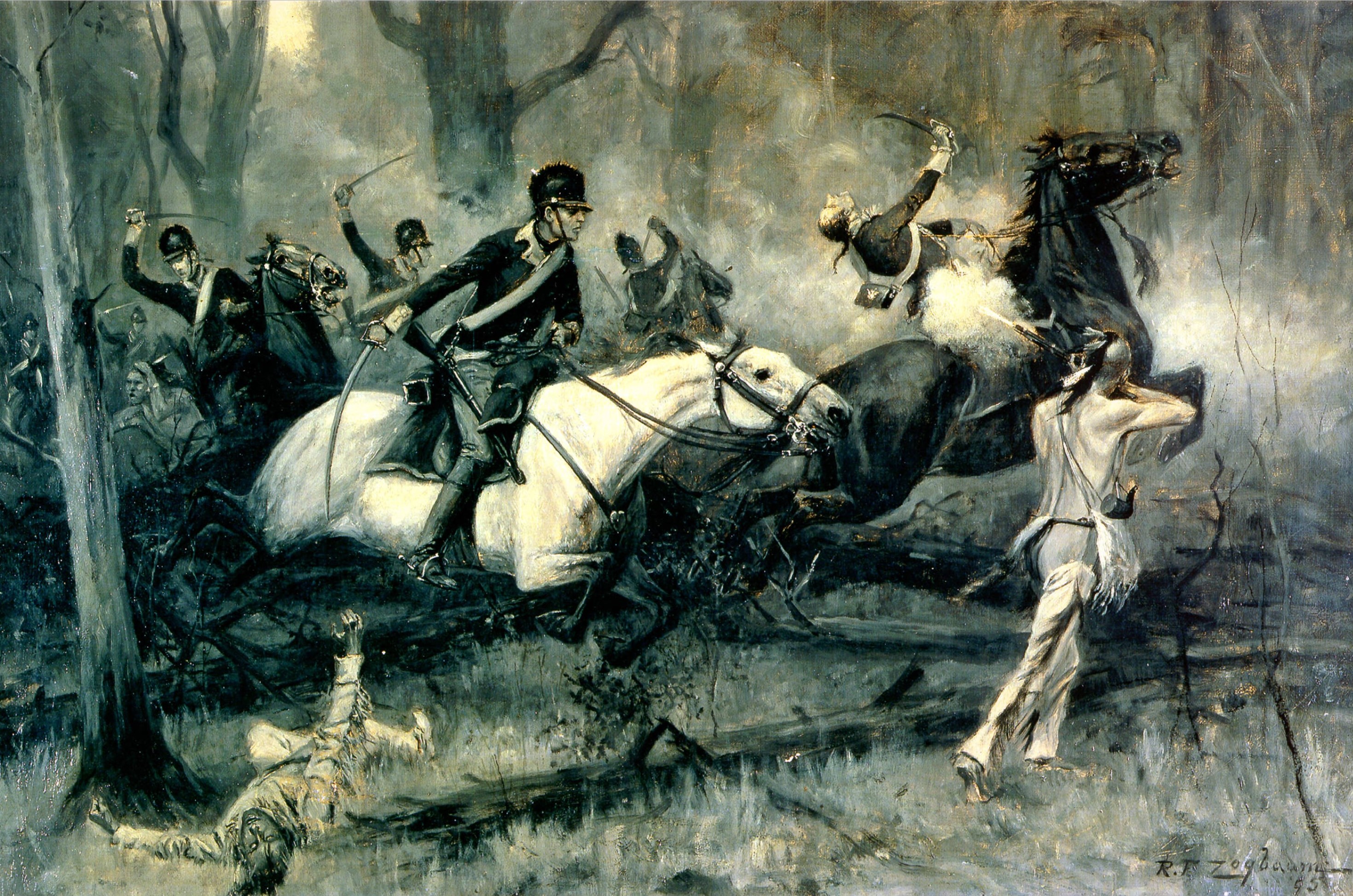 "Charge of the Dragoons at Fallen Timbers," by R. T. Zogbaum for Harper's Magazine, 1895
On 17 Aug 1794, Wayne departed Fort Recovery and pushed north, buttressed by about 1,000 mounted Kentucky militia under General Charles Scott. The Legion constructed Fort Adams (Rockford, Ohio) and Fort Defiance. Finally, as the Legion approached Fort Miami, Wayne stopped to build Fort Deposit as a baggage camp so that the Legion could go into battle as light infantry.
Little Turtle had ceded command of the Western Confederacy to Blue Jacket who was now ready to confront Wayne's Legionnaires. Blue Jacket assumed a defensive position along the Maumee River near a copse of fallen trees and close to Fort Miami, assuming that the fallen trees would slow the advance of Wayne's men. On August 20, Wayne attacked Blue Jacket's position and his superior numbers and trained men quickly began to rout the Indians out of their position. The entire battle lasted little more than an hour. With the American dragoons attacking their flank, the confederacy's warriors fled towards Fort Miami. But after supporting Native resistance to American expansion for years, British thinking had changed. Britain was now at war with France, and needed access to American foodstuffs and military stores. The commander of Fort Miami, not wishing to start another war with the Americans, had closed the gates. The Western Confederacy's men had to flee and Wayne ordered his troops to burn all of the villages and crops in the area and then withdrew to Fort Greene Ville.
Aftermath
In the fall, Wayne had the Legion build Fort Wayne near Kekionga, which helped show U.S. control over the large Native American city, and secured the strategic portage between the Maumee and Wabash rivers.
The Jay Treaty between the United States and Great Britain was signed on November 19, 1794, and resolved many of the issues remaining since the end of the Revolutionary War. The British also agreed to return American merchant ships engaged in trade with the French West Indies that they had seized, and to finally abandon their military forts in the Northwest Territory (which they were technically already supposed to have vacated under the 1783 Treaty of Paris).
On 3 August 1795, as a result of the Army's victory at Fallen Timbers and the Jay Treaty, leaders of the Northwestern Confederacy signed the Treaty of Greenville, essentially ending the Northwest Indian War.
In 1796, as stipulated in the Jay Treaty, Wayne accepted the handover of all eight British forts in the southern Great Lakes Region, and the Legion of the United States was reduced in size and rechristened the "Army of the United States."