|
| |||
|
| |||
|
| |||
|
| |||
|
| |||
|
|
|||

|
|||
|
| |||
|
| |||
|
| |||
|
This site was last updated on 06/15/2005 | |||
|
| |||
|
Welcome to the Estill County site within the KYGenWeb project In the spring of 1996, a group of genealogists organized the Kentucky Comprehensive Genealogy Database Project, which evolved into the KyGenWeb Project. The idea was to provide a single entry point for genealogy data and research for all counties in Kentucky. In addition, the information for each county would be indexed and cross-linked to make it easier for researchers to find a name or data that they sought. In June 1996, as the KyGenWeb Project was nearing 100% county coverage, interested volunteers decided to create a similar set of pages for all states, establishing The USGenWeb Project. Volunteers were found who were willing to coordinate the efforts for each state, and additional volunteers were and are being sought to create and maintain websites for every county in the United States. Your county coordinator for Estill County is Harlan Sloan. | |||
|
| |||
|
This site is generously | |||
|
|
|||


Please do not enter queries in the guestbook. They will be deleted.
Please use the Query Forums for that.
Due to circumstances beyond our control, we had to get a
guestbook.
|
|||
|
|
|||
|
Due to circumstances beyond our control, we had to get a new counter. |
|||
|
|
|||
| If you submitted something to this site and do not see it here, please contact Harlan . | |||
|
|
|||
| |||
|
|
|||
|
|





|
|
|
|
| Today is
|
|
|

| We are currently revising this site. We realize there are pages with Jennifer Fish's email still listed. We are working to get that changed. Please only contact Harlan | ||
|
| ||
|
||
|
| ||
|
Help Needed! What kind of help do we need? Take a look to the right! Right now, we're especially interested in family information and/or photographs. If you're interested in contributing information to this site for other researchers, contact me. However, please make sure that you do not include information on living people. When submitting information, please do not submit anything you have not generated yourself or that violates copyright law. | ||
|
| ||
|
| ||
|
Estill
County Public Library | ||
|
| ||
|
Estill County Historical &
Genealogical Society | ||
|
| ||
|
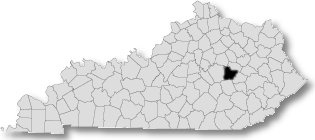
Estill County, the 50th in order of formation, was established on February 19, 1808, from parts of Clark and Madison counties. It was named in honor of Capt. James Estill, who was killed by Indians during Estill's Defeat on March 22, 1782. The county is located in eastern Kentucky and comprises an area of 256 square miles, bordered by Clark, Jackson, Lee, Madison, and Powell counties. Parts of Estill County were used in forming Breathitt County in 1843, Jackson County in 1858, Lee County in 1870, Owsley County in 1843 and Powell County in 1852. The county seat is Irvine. Irvine is on the Kentucky River at Station Camp Creek and at the intersection of KY 52 and KY 89. It was founded in 1812 and named for Colonel William Irvine, an early settler. An Irvine or Estill Court House post office opened in 1813. Irvine is home to the annual Mountain Mushroom Festival which is held in the last week of April. The elevation in the county ranges from 566 to 1511 feet above sea level. Although mostly hilly, the fertile bottomlands are highly productive agricultural areas. Large crops of tobacco and alfalfa are grown, and there is limited livestock production. Extensive quantities of coal and smaller deposits of oil, iron ore, and lead are also found in the county. Approximately 75 percent of Estill County is forest, of which 4,458 acres lie within the Daniel Boone National Forest. Along with the Kentucky River, the principal streams of the county are the Red River and the Station Camp, Beech, Cow, Downing, and Miller's creeks. Prior to pioneer settlement, Estill County was the site of a Shawnee village at Estill Springs, along the banks of Station Camp Creek. In the 1760s and 1770s, after John Finley, Daniel Boone, and Robert McAfee explored the area, many early settlers entered the region by way of an old buffalo and Indian trace that led to Boonesborough in what is now Madison County. The mineral wealth of the region played an important role in the development of the county. The Shawnee mined lead in the area, and early settlers recognized the industrial potential of the region. The production of iron began in about 1810 and became one of the earliest industries. Evidence of the once-thriving iron industry can be found in the ruins of the Estill steam furnace, which operated from 1830 to 1874; the Cottage furnace; the Red River iron works; and the Fitchburg furnace. The iron industry declined after 1865 when iron deposits and timber to fire the furnaces were depleted, and innovations in the iron industry made charcoal furnaces obsolete. The large hotel and landscaped grounds at Estill Springs drew many famous Kentuckians to the summer retreat before the Civil War. Henry Clay, who owned the springs, John Crittenden, and John C. Breckinridge were among the notables who summered there. The resort survived the Civil War and operated into the twentieth century. Among the towns, villages, and communities in Estill County are the communities of Ravenna, Fitchburg, North Irvine, Sand Hill, South Irvine, and West Irvine. The population of Estill County was 12,752 in 1970; 14,495 in 1980; and 14,614 in 1990. From The Kentucky Encyclopedia, edited by John Kleber. Copyright 1992 |
|
|
|
|
|
|
|
|
Once the addition/update to
this site is over one week old, the graphic and date will be removed
from the index
|
|
|
|
What County is it in? |
|
|
|
|

|
|
|

|
|
|

|


